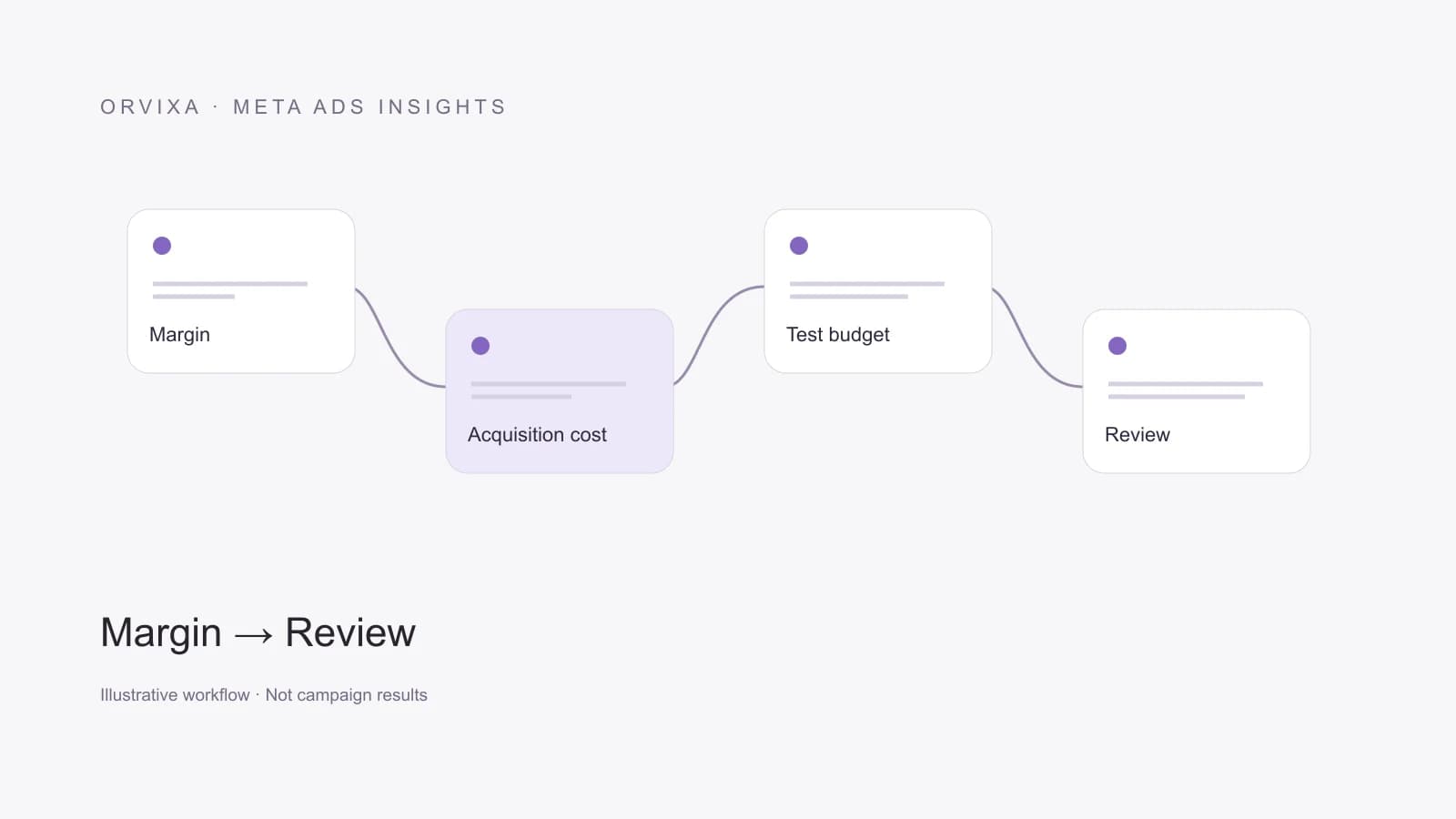
Start with the business model
There is no universal Meta ads budget that makes sense for every business. Two companies selling similar products can have different margins, repeat purchase behaviour and operational costs. Copying another company’s spend is therefore not a financial plan. First define the commercial outcome the advertising should support. Then work out what that outcome is worth and how much uncertainty the business can afford while learning.
Revenue is not the whole calculation. Product cost, shipping subsidies, payment fees, returns and other variable expenses reduce the contribution from an order. For a service business, delivery time and available capacity also matter. A campaign that produces more enquiries than the team can handle is not automatically a success. Orvixa treats the starting budget as part of this commercial context rather than as an isolated media recommendation.
Set an acquisition cost boundary
Consider a hypothetical order that leaves 100 units of contribution before advertising. Spending all 100 units to acquire that order may leave nothing for fixed costs or profit. This is an illustration of the method, not a market benchmark or an Orvixa result. Your acceptable acquisition cost must come from your own economics. Include repeat purchases only when there is reasonable evidence to support the assumption.
Lead generation requires another step. Not every enquiry becomes a sale, so cost per lead cannot be evaluated alone. Track qualification and sales conversion as well. If those rates are unknown, treat the first phase as a controlled learning period. Write down the assumptions and revise them as evidence arrives. A low-cost form submission can be expensive if almost none of the contacts have a relevant need.
Avoid fragmenting a limited budget
Creating a separate campaign for every location, audience idea and design may look organised, but it can leave each test with too little information to interpret. Ask which distinctions have a commercial reason. Separate markets, offers or sales teams may justify different treatment. Simply wanting more rows in a dashboard does not. The structure should make decisions clearer, not create detail for its own sake.
Choose the most important uncertainty before allocating a test budget. Perhaps people do not understand the offer, abandon the form or contact the business with unsuitable requirements. Each problem needs a different investigation. Changing many things simultaneously makes it harder to identify what helped. Effective management is partly the discipline of deciding which question deserves resources next and what evidence would change the decision.
Separate spend from service costs
The amount paid to Meta is different from an agency’s management fee. Creative production, landing-page work and measurement setup may also be separate. Include all relevant costs when considering the total investment, but keep the categories visible. Treating platform spend as the complete cost of acquisition can make a campaign appear more profitable than the business actually experiences.
In a proposal with Orvixa, clarify which tasks are initial projects and which recur. Measurement setup may be concentrated at the beginning, while creative work may continue through the engagement. The pattern depends on the account. A written scope and an approval process for additional work make budget changes easier to understand. They also prevent essential production tasks from becoming unexpected expenses after the media plan has been approved.
Increase spending only with context
One strong day is rarely enough to establish a repeatable result. Review completed sales, cancellations, lead quality and measurement consistency. More spend does not guarantee the same acquisition cost because the campaign may enter different auctions and reach different people. Compare periods carefully and account for changes in offers, stock, response capacity or seasonality before attributing every movement to a budget adjustment.
Set a review point and stopping conditions in the initial plan. Make the acceptable cost range, missing evidence and operational limits explicit. The aim is not to increase the budget at all costs; it is to establish a useful acquisition process. A Meta advertising budget is a decision that should evolve with evidence, not a magic number that an agency can promise will produce a fixed return.
Practical exercise
In your first working file, put target sales or qualified enquiries, acceptable acquisition cost, media spending and production fees on separate rows. Mark every figure as actual data or an assumption. Define which findings should lead to a budget change. For example, a measurement failure may require pausing evaluation, while a lack of suitable enquiries may call for reviewing the offer. These are starting conditions for discussion, not automatic rules. Assign an owner to the table and keep change dates, so the original budget rationale remains clear a month later. Compare old assumptions with actual results rather than deleting them when updating figures. Learning comes from explaining the difference between expectations and outcomes, not merely recording spending.