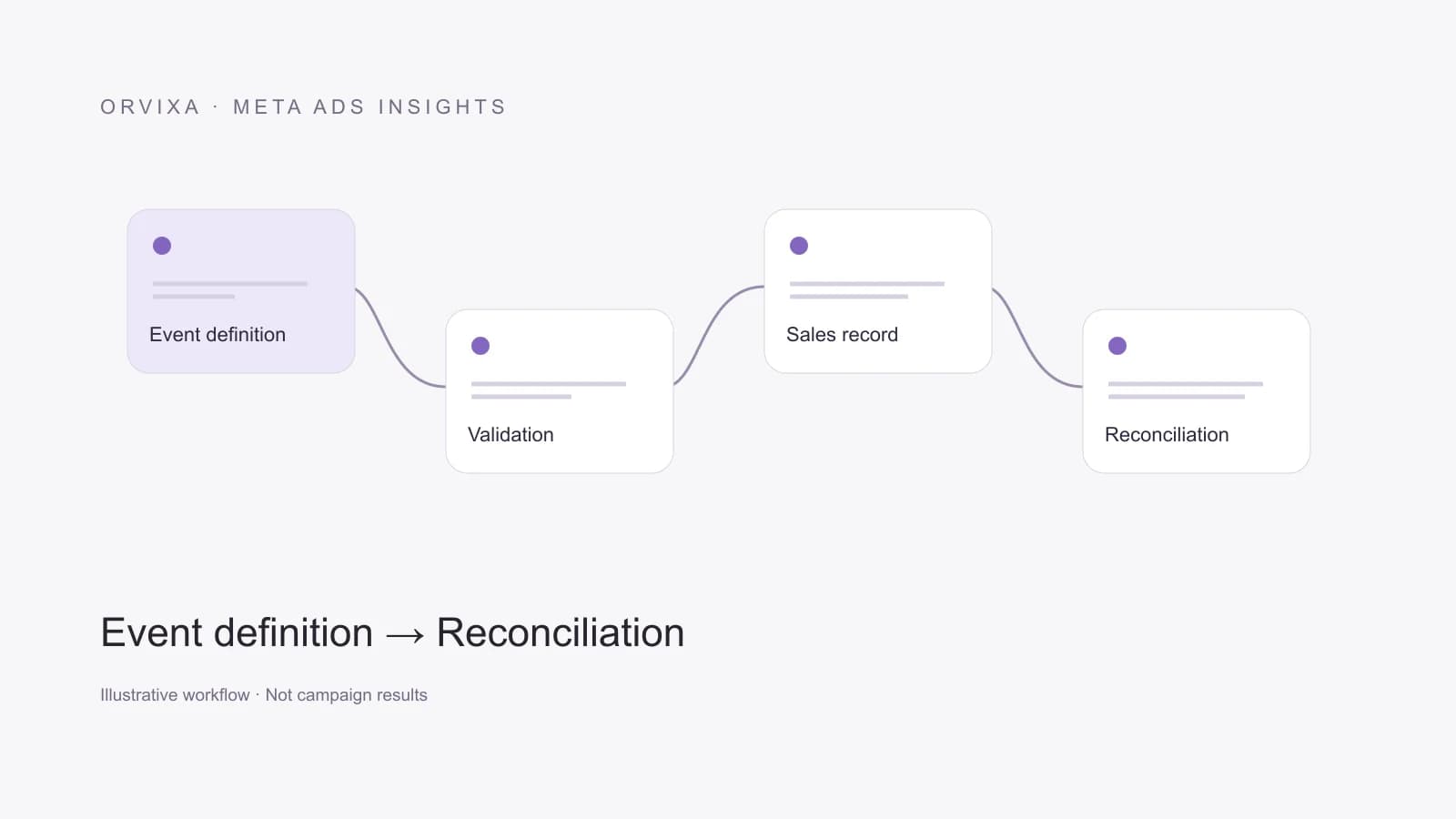
Define the event before installing the code
Meta conversion measurement is not complete when a script is added to a website. First decide what behaviour counts as success. Clicking a button, successfully submitting a form and paying for an order are different events. If they are grouped carelessly, the campaign can be evaluated against outcomes that never happened. Loading a checkout page should not be confused with completing a purchase.
Create a short event dictionary with the business team. When does a lead exist? When is a sale final? How are cancellations recorded? These definitions make the technical implementation and the report easier to understand. Orvixa approaches measurement as a connection between advertising data and business records. Two systems using the same label does not necessarily mean they are counting the same action.
Understand browser and server reporting
Browser measurement can be affected by user choices and technical conditions. Server-side reporting provides another way to communicate events, but it is not unlimited or perfect tracking. The purpose, data scope, permissions and validation need to be considered together. Sending more information does not automatically improve accuracy. A poorly defined event can simply become a more consistently reported mistake.
When the browser and server both report an action, review the possibility of duplication. The identifiers used to associate the reports should represent the same real event. A connection appearing healthy does not remove the need for this check. Following a test transaction through both the business record and the measurement system can be more informative than completing a series of settings screens. Any real-charge test needs separate control.
Test more than the happy path
Consider form failures, cancelled payments, refreshed pages and repeated notifications. A failed submission counted as a conversion can inflate reporting. A thank-you page that records a new sale every time it opens can introduce duplicate outcomes. Understand the application’s behaviour before assuming that the numbers in an advertising dashboard reflect commercial reality. Test cases should follow plausible customer journeys.
Keep development activity separate from live reporting. Check event names, currency, amounts and order identifiers for consistency. Avoid exposing unnecessary personal information in diagnostic logs. Investigating a problem does not require making every customer detail visible. Limited event information or anonymised examples are often enough to confirm whether the technical flow is behaving as intended and to identify where further investigation is needed.
Distinguish attribution from incremental effect
A platform attributing a sale to an advertisement does not prove that the sale would never have happened without it. Reporting tools may use different windows and methods. Exact agreement between dashboards is therefore not always a reasonable expectation. What matters is understanding the likely reasons for a difference and taking those limitations into account when making decisions about budget or campaign direction.
Use confirmed business transactions as an important reference point. Returns, cancellations and repeat customers may need separate treatment. Orvixa considers media performance alongside commercial outcomes for this reason. Making uncertainty visible is more useful than hiding it behind a single confident figure. No individual tool provides a perfect account of every interaction that influenced a customer’s decision to buy.
Maintain the implementation after launch
A website release, new form or payment provider can change the event flow. Do not assume that an implementation remains correct because it once worked. Repeat core checks after important changes and make responsibility for measurement clear. When results move unexpectedly, checking the data pipeline before changing the campaign can prevent a technical fault from being mistaken for a marketing problem.
A useful measurement handover includes event definitions, tested scenarios, known limitations and ownership of future checks. It should give the developer, marketer and business owner a shared interpretation of the numbers. The objective is not the most crowded report. It is a decision-making foundation whose reliability can be explained. That makes performance discussions more precise and helps avoid optimising towards events that do not represent genuine business progress.
Practical exercise
During technical handover, choose one example transaction and record each step from start to finish. Check form validation, record creation, measurement notifications and duplicate counting separately. Keep test information separate from real customer data. This short record helps a new team understand the system if ownership changes. Also specify who should be notified when expected event counts change unusually. Verify definitions and the technical flow before changing campaign budgets in response to every numerical discrepancy. This small checklist can shorten the time a report is affected by incorrect data. Record the date of the check as well.