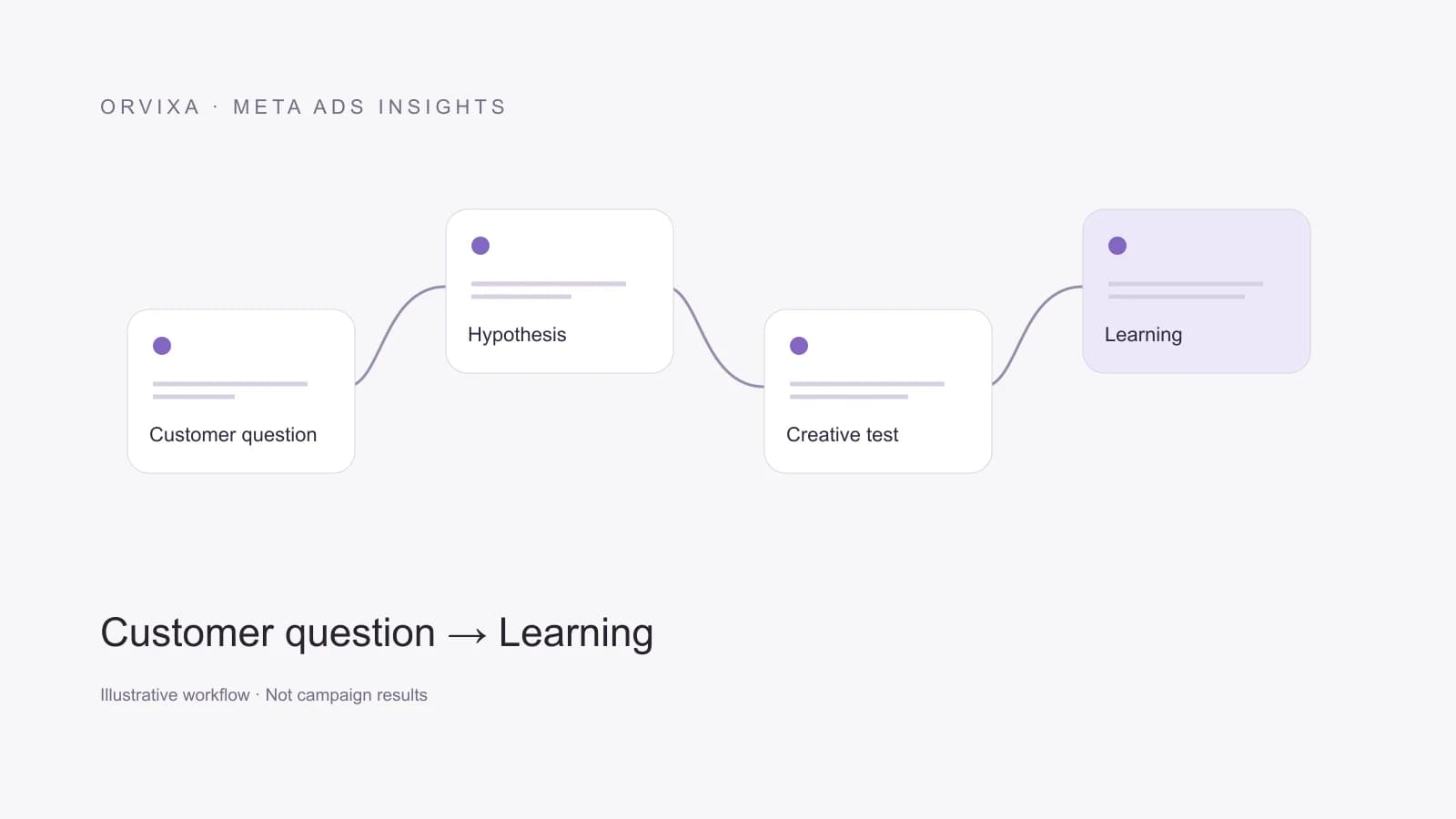
Begin with a hypothesis, not a design file
A Meta creative test is more than five colour variations of the same image. Start with a customer question. Is the product difficult to understand, is the value unclear, or does the buyer need reassurance about the process? A useful test proposes an answer. For example, a demonstration may produce more relevant enquiries than a list of features because it makes the service easier to imagine using.
Writing down the hypothesis helps the team interpret the result. A strong outcome becomes something to investigate rather than simply celebrate; a weak one does not require abandoning the entire visual identity. Orvixa considers creative alongside the campaign objective. Its role is not only to attract attention but to help the right person understand the offer and arrive at the next step with appropriate expectations.
Find the language customers actually use
Repeated sales questions, support enquiries and confusing product explanations are useful starting points. Understanding how people describe a problem can be more productive than inventing a broad slogan in a meeting. This does not mean copying private customer information into advertisements. Separate recurring themes from personal details and identify which questions genuinely influence the purchase decision.
Avoid making every asset answer everything. One creative might explain ease of use, another the delivery process and another the scope. These are meaningfully different ideas. Let the headline and supporting copy complement each other instead of repeating the same sentence. The landing page must also support the promise. Otherwise an engaging advertisement can generate interest that disappears as soon as the visitor tries to understand the actual offer.
Let the message guide the format
A process may be easier to explain in a short video, while a concise comparison may work well as a static asset. Video is not automatically better, and an image is not automatically inadequate. Consider the information, production constraints and intended placements together. Small text or an ambiguous opening frame can prevent a good idea from being understood on a mobile screen.
When producing video, consider whether the central message works without sound. Build a clear sequence from introduction to demonstration and next step. Do not fill the creative with artificial urgency. If a deadline or limitation is not real, do not present it as one. Advertising creates expectations about the business as well as clicks, so the accuracy of the message belongs in the production process.
Keep comparisons interpretable
If the message, offer and destination all change together, it becomes harder to explain the difference in results. It is possible to test a complete concept, but label it as such. Record the versions, dates and question being explored. Two advertisements running under different conditions are not a perfectly controlled experiment. Auction conditions and demand can shift even when the creative is the only intentional change.
Do not select a winner from click-through rate alone. A curiosity-driven headline can attract attention while creating unsuitable expectations. Review lead quality, purchases and the landing experience where the data supports it. In planning work with Orvixa, agree how the test will be evaluated as well as how many assets will be produced. A folder full of designs is not the same as an organised learning process.
Turn results into a better brief
A successful asset should become more than a file to duplicate. Record what the result suggests about the customer. If use cases appear more persuasive than feature lists, the next production brief can explore that idea further. But avoid turning one observation into a universal rule. Different offers, periods and markets can respond differently, and subsequent evidence may change the original interpretation.
At the end of the cycle, the team should have better questions as well as finished assets. Which objection matters? Which explanation is missing? Which format can be produced consistently? Those answers help direct the next investment. This is how Meta creative testing becomes cumulative rather than random. Connecting production and campaign management makes it easier to turn what is learned into the next useful piece of communication.
Practical exercise
Start the next production brief with three lines: the customer’s question, the evidence you will show and the intended next step. Check how each design answers them. Evidence may be a product demonstration, a clear explanation of scope or an example used with permission. Without real data, show the process instead of inventing a success chart. Dates and idea codes in filenames make review easier. Record which observation supports each interpretation instead of writing only good or bad. Refer to the earlier record when trying the same idea in another format. This preserves production reasoning through team changes and avoids starting from scratch every period. The archive becomes a usable source of learning.