Cheap enquiries are not always valuable
A rising form count can look encouraging while the sales team is struggling to reach anyone. Some contacts may need a different service, lack the necessary budget or live outside the area you serve. Cost per lead alone cannot describe this situation. Start by defining a qualified lead in terms your team can actually use. Marketing and sales need to agree on that definition before interpreting campaign performance.
Relevant criteria might include location, type of requirement, timing and purchasing responsibility. Not every business needs the same questions. Collect information that helps assess suitability rather than adding fields simply because the form allows them. In a lead generation discussion with Orvixa, the goal is to understand how an enquiry progresses into a useful conversation, not only how to create more database entries.
Match the advertisement to the next step
If the advertisement suggests free advice but the follow-up immediately sells a paid service, expectations may be misaligned. A very broad creative can also attract people with unrelated needs. Explain who the offer is for and what happens after submission. The promise that encourages the click should continue in the form and the sales conversation. Audience settings cannot repair a fundamentally confusing proposition.
Clearer qualification may reduce total enquiries while improving the proportion that is relevant. That does not automatically make it better, but it changes what should be measured. Compare qualified lead cost and completed sales, not just the number of submissions. Equally, a lower volume is not proof of higher quality. The evidence needs to connect the initial contact with an outcome the business values.
Choose form friction deliberately
A short form is easy to complete but may provide little context. A longer form can help qualification while discouraging suitable prospects. Review each question and ask what decision it supports. Information that determines service eligibility is different from information that can comfortably be collected later. Treat the form as part of an experiment, rather than choosing its length based on appearance alone.
Use the confirmation message to explain the next step and the channel through which the business will respond. Do not promise a response time the team cannot deliver. Keep privacy information and optional marketing preferences distinct, with appropriate professional advice for the market involved. Optimisation does not justify collecting unnecessary personal information. A clear and proportionate process protects the customer experience as well as the usefulness of the data.
Bring sales feedback into the picture
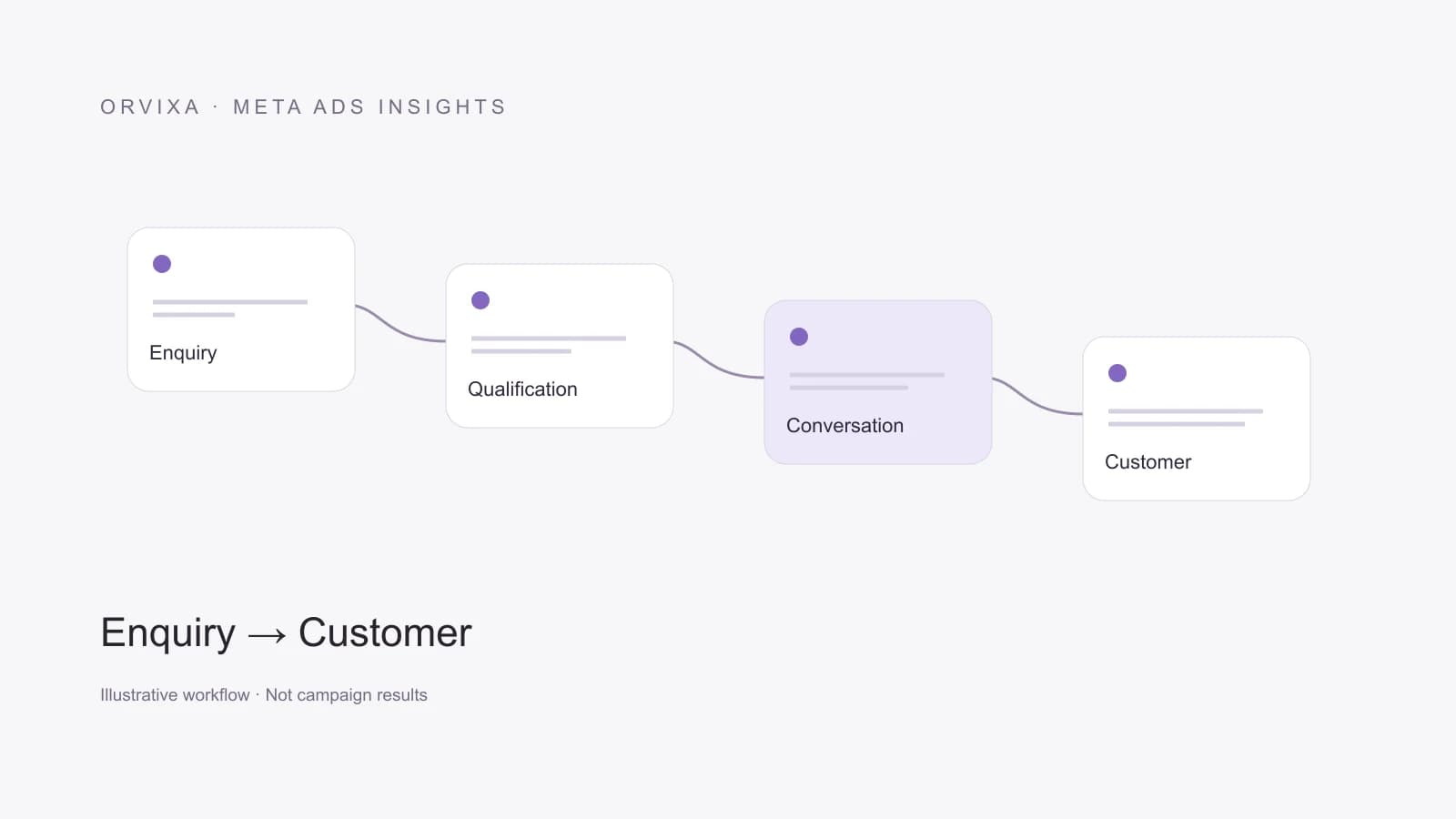
Keeping a list of names is not the same as tracking outcomes. Use understandable stages such as contacted, qualified, proposal sent and won. Without this progression, it is difficult to know what the advertising should improve. Slow responses can create losses unrelated to targeting. A missed call or an unanswered message may explain weak sales even when the campaign is attracting relevant people.
A CRM or a disciplined tracking process can connect campaign sources to commercial results. If data is sent back to an advertising platform, its scope, permissions and technical validation need separate attention. Orvixa aims to make this feedback useful for campaign decisions. However, even a correctly connected system cannot produce reliable insight when stages are applied inconsistently. Sales recording discipline matters as much as advertising settings.
Allow time for the sales cycle
Some services take weeks to sell. Comparing today’s enquiries only with today’s sales can therefore be misleading. Review comparable groups of leads after an appropriate interval, and record changes to the offer or sales process. This makes it easier to discuss whether a movement in cost may be related to campaign execution, operational changes or simply the time needed for decisions.
Start the review with three questions: are the right people arriving, can the team respond effectively, and does the offer meet their expectations? This is a stronger foundation for Meta advertising than maximising submissions in isolation. When lead volume, quality and processing capacity are visible together, the next budget decision becomes more grounded. A successful acquisition process needs both the campaign and the business to work.
Practical exercise
For one week, group the reasons for suitable and unsuitable enquiries without sharing personal details. Separate reasons such as being outside the service area, needing a different service, incompatible timing and being unreachable. Do not automatically treat someone you could not reach as uninterested; response timing or the communication channel may matter. Choose the two most frequent reasons and discuss whether the advertising message or form can clarify them. Avoid changing the entire process at once. Continue using the same groups in the next period to see whether the difference lasts. This turns a general complaint about poor leads into concrete feedback. The campaign manager needs the reason behind the label to act on it.